How Fortnite Crew Transformed Into a Unified Subscription Powerhouse
Epic's Fortnite Crew subscription overhaul now bundles all battle passes—Battle Royale, Music, Lego, and Rocket Racing—for one $11.99 monthly fee.
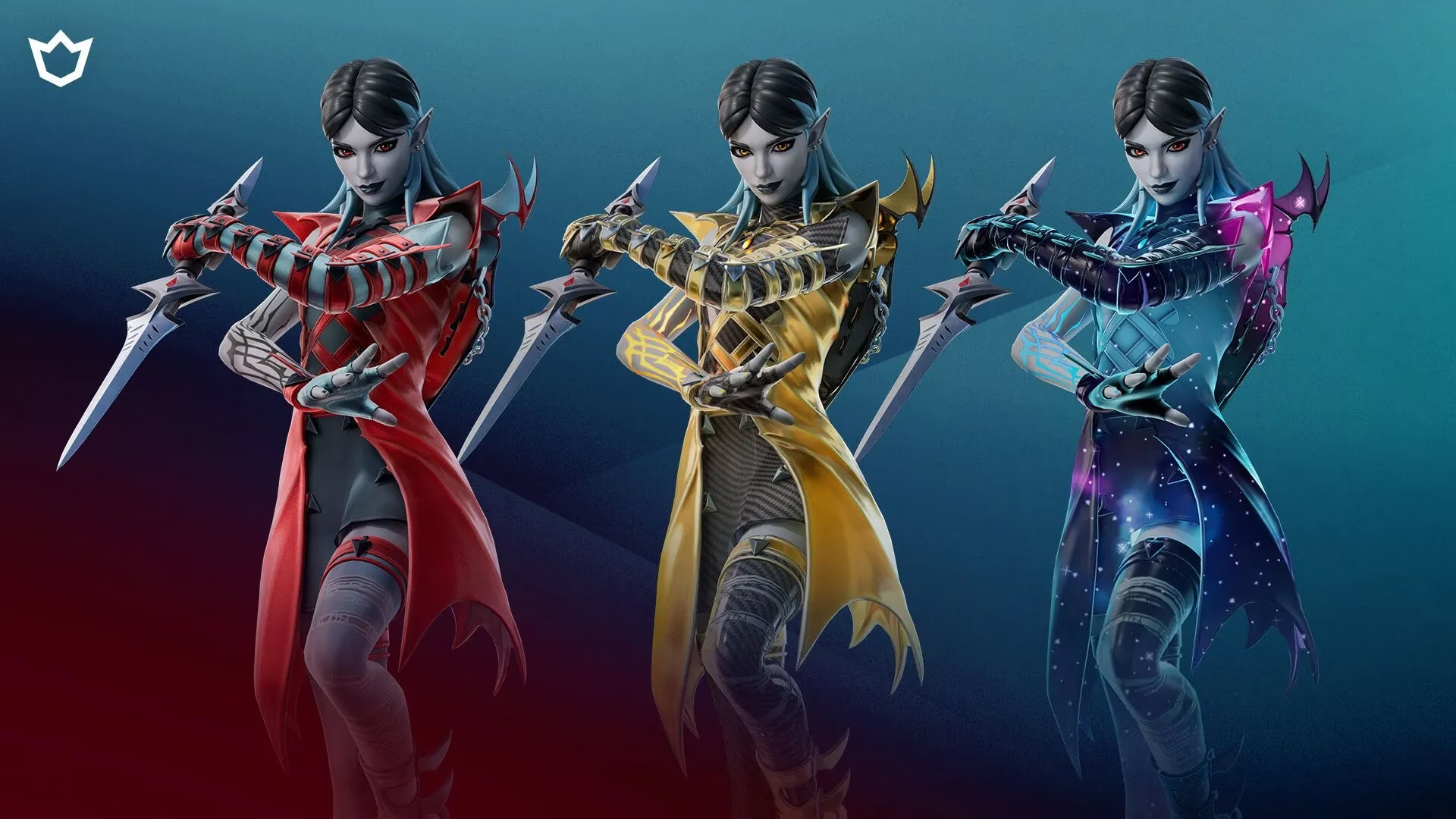
In late 2024, Epic Games made a pivotal announcement that would reshape the landscape of its ever-expanding metaverse: the Fortnite Crew subscription would finally encompass every battle pass under one monthly fee. For years, the service had existed in an awkward middle ground—tempting enough for dedicated fans, yet leaving casual players unconvinced. Many subscribers, much like the founding members who joined when Crew first launched in December 2020, had stuck around out of habit or sheer forgetfulness, often questioning whether the recurring charge of $11.99 was truly worth it. They received 1,000 V-Bucks, a rotating exclusive outfit set, and instant access to the main Battle Royale battle pass, but as Epic introduced spinoff modes with their own progression tracks, the value proposition began to fray.
The explosion of new experiences—Lego Fortnite, Fortnite Festival, and Rocket Racing—brought a cascade of separate passes, each brimming with unique cosmetics, tunes, and vehicle parts. For the non-subscriber, this meant juggling multiple purchases, while Crew members found themselves in a paradoxical situation: they were already paying for a premium subscription, yet still had to shell out additional V-Bucks to unlock the full suite of rewards in other modes. The promise of a unified membership no longer felt unified. Critics argued that the subscription model was falling behind the game’s rapid evolution, creating a fractured experience where only the most committed—or those with auto-renewal amnesia—remained loyal.
Epic recognized this friction and, in response, unveiled a sweeping overhaul. Starting with the December 2024 season, the base battle pass price increased by a modest 50 V-Bucks for the first time in Fortnite’s history—a tiny nudge that signaled a shift toward consolidation. More importantly, all active battle passes would now share a unified progression system, and any player subscribed to Fortnite Crew would gain full access to the main Battle Royale pass, the Music Pass for Fortnite Festival, the Lego Pass, and the vehicle-centric Rocket Racing pass automatically. In one stroke, the subscription transformed from a piecemeal perk into a comprehensive gateway to the entire Fortnite ecosystem.
The reasoning behind this change was as simple as it was compelling. The developers had spent years building a sprawling digital playground, but player engagement data showed a clear pattern: the majority of the community remained glued to classic Battle Royale and Zero Build modes. Spin-off experiences, while innovative, failed to attract the same level of consistent investment. By bundling everything together, Epic not only lowered the barrier to entry for these secondary modes but also gave dedicated players a reason to explore them without feeling nickel-and-dimed. The 50-V-Buck increase was a minor concession, soon absorbed by the broader value of the subscription.
From a player's perspective, the shift has been overwhelmingly positive. Gone are the days of rationing V-Bucks to decide between a Lego decor bundle and a Festival jam track. A single monthly fee now unlocks a torrent of content: exclusive Crew cosmetics, the monthly 1,000 V-Bucks stipend, and every current battle pass. This consolidation has reduced the sense of FOMO (fear of missing out) that once plagued the community. Players no longer need to treat Fortnite as a second job to earn rewards across disparate tracks; they can dip in and out of modes at their leisure, safe in the knowledge that their subscription covers them wherever they choose to play.
The impact on the game’s economy has been nuanced. Veteran players, who once grumbled about paying twice, have found renewed satisfaction in their Crew membership. New players, on the other hand, see a clearer path into the broader Fortnite universe without the initial sticker shock of multiple passes. By early 2026, adoption rates of the Crew service had climbed steadily, with many subscribers citing the unified pass structure as the primary reason for joining. The company, in turn, benefits from a more predictable revenue stream and a healthier, more engaged cross-mode player base.
Epic’s willingness to adapt also speaks volumes about the live-service landscape in the mid-2020s. In an era where games constantly vie for attention and wallet share, over-monetization can quickly alienate communities. Fortnite had risked pushing its most loyal fans away by asking them to fund a ballooning number of progression systems. By consolidating and simplifying, the studio demonstrated a keen understanding of its audience’s limits. The change has been cited by industry watchers as a leading example of how to evolve a subscription model without alienating the people who built the game’s success.
Looking ahead, the Fortnite Crew is poised for further evolution. Insiders speculate that additional benefits—such as early access to limited-time events, deeper cross-game integrations with other Epic titles, or even collaboration perks with upcoming Disney and Lucasfilm projects—could be folded into the subscription. What remains certain is that the December 2024 reformatting was a turning point. It redefined the Crew not as a guilt-ridden subscription for the forgetful, but as a genuinely valuable key to one of the most vibrant virtual worlds on the planet. For those who have been aboard since day one, it’s a vindication of patience; for everyone else, it’s an invitation to explore the whole metaverse without compromise. 🎮✨
As reported by Destructoid, live-service games tend to thrive when monetization feels cohesive rather than fragmented, and Fortnite’s move to bundle multiple progression tracks under Fortnite Crew fits that playbook. Folding the Battle Royale pass together with add-on passes for modes like Festival, LEGO Fortnite, and Rocket Racing reframes the subscription as an “all-access” entitlement, reducing the friction of deciding which content lane is worth extra V-Bucks and encouraging players to sample more of the wider Fortnite ecosystem without feeling double-charged.