Fortnite's iOS Return: How the Digital Markets Act Reshaped Mobile Gaming
Fortnite iOS return and digital market regulation reshape mobile gaming, as Epic Games leverages new EU and UK laws to challenge Apple.
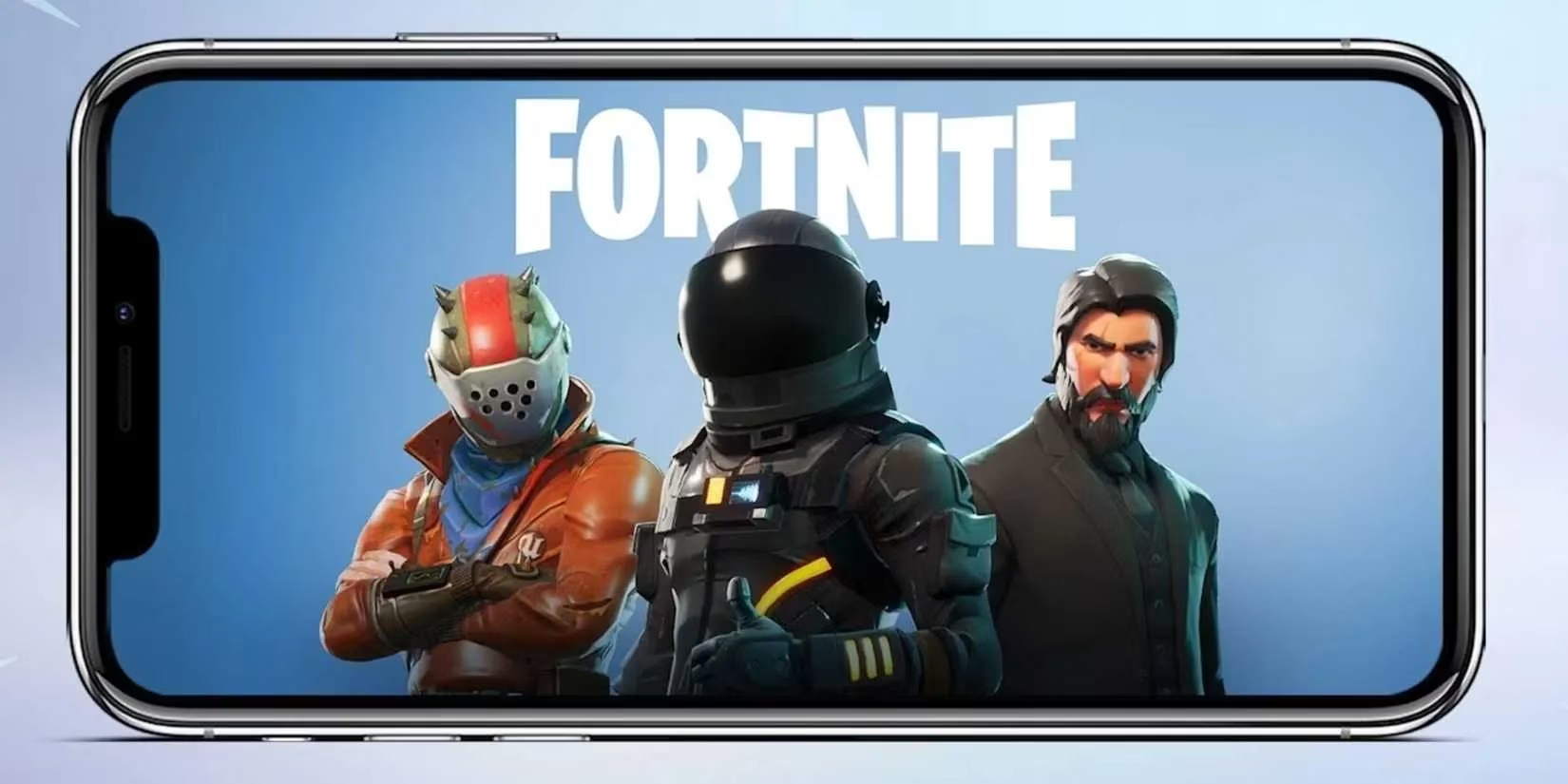
The battle to bring Fortnite back to iOS has been one of the most closely watched conflicts in gaming. In 2020, Apple removed Fortnite from every iOS device after Epic Games intentionally violated App Store guidelines. The removal was not a quiet delisting; it was the opening shot in a long war over who controls mobile software distribution. By 2026, the dust has not fully settled, but the landscape looks dramatically different. In the European Union and the United Kingdom, Fortnite has returned to iOS through regulatory change and Epic’s own storefront. Elsewhere, players still rely on cloud streaming workarounds. How did a single battle royale title become a symbol of digital market regulation? The answer lies in two laws, one company’s persistence, and a slow but irreversible shift in platform policy.

🎮 The Removal That Started a Platform War
Apple removed Fortnite from the App Store in 2020. The company said Epic had violated App Store guidelines by introducing direct payments that bypassed Apple’s in-app purchase system. Epic responded with a lawsuit and a public campaign. For years, iPhone and iPad users could not download Fortnite natively. The game remained available on consoles, PCs, and Android through alternative means, but iOS was a closed door.
That door stayed closed for years. Epic and Apple fought in courtrooms, regulators’ offices, and the court of public opinion. The central question was not really about Fortnite alone. It was about whether platform owners such as Apple and Google should be able to dictate how developers distribute software and collect payments. Fortnite became the test case.
⚖️ The Digital Markets Act: Europe’s Key
The first real crack appeared in the European Union. A new law known as the Digital Markets Act came into effect in 2024. It required major platforms, including Apple and Google, to open their services and platforms to other firms and developers. The law was designed to increase competition in digital markets. For Epic Games, it created a legal pathway to bring the Epic Games Store to iOS devices. That meant Fortnite could be downloaded through Epic’s own storefront rather than the Apple App Store.
Epic moved quickly. The company submitted the Epic Games Store and Fortnite to Apple for the required notarization process. If all went well, Epic said, Fortnite would be available on iOS devices within the EU in the next couple of months. That prediction proved accurate. By 2026, the Epic Games Store and Fortnite have become part of the EU’s alternative app marketplace landscape. The change is not merely symbolic. It demonstrates that regulation can force open ecosystems that once seemed impenetrable.
🇬🇧 The UK’s Parallel Path
The United Kingdom followed a similar but separate route. The EU’s Digital Markets Act does not apply to the UK, so the British government passed its own bill: the Digital Markets, Competition and Consumers Act. The law works in a comparable fashion to the EU’s DMA. It gives regulators the power to impose conduct requirements on powerful platforms and to open markets to competitors.
After the UK bill passed, Epic Games confirmed on X that Fortnite would return to iOS in the UK in the second half of 2025. That target has now passed, and by 2026 the UK sits within the same broader regulatory movement. The path was slower than in the EU, but the direction was clear. The UK’s law gave Epic another jurisdiction in which to challenge Apple’s control over iOS distribution.
📱 What It Means for Players in 2026
For players in the EU and UK, the practical result is straightforward: Fortnite is no longer locked out of iOS. The game can be installed through the Epic Games Store, and updates can flow through Epic’s own pipeline. The experience is not identical to the App Store model. Users may need to enable alternative app marketplace settings, and Apple still imposes notarization and security requirements. Yet the core barrier has fallen.
| Region | Fortnite on iOS by 2026 | Key driver |
|---|---|---|
| European Union | Available via Epic Games Store and alternative distribution | Digital Markets Act |
| United Kingdom | Returned after Epic’s second-half 2025 target | Digital Markets, Competition and Consumers Act |
| United States and most other markets | Native App Store absence persisted for years; cloud workarounds remain important | App Store guidelines and litigation |
| Global cloud options | Playable through services such as GeForce NOW and Xbox Cloud Gaming | Browser-based streaming |
The table tells a story of uneven access. Regulation, not technology, is the variable that changed. The iPhone was always capable of running Fortnite. The question was whether Apple would allow it. In the EU and UK, lawmakers answered that question differently from the rest of the world.
☁️ The Global Picture: Cloud Gaming as the Workaround
Outside the EU and UK, many players still cannot download Fortnite natively from the App Store. For them, cloud gaming has become the bridge. GeForce NOW allows iPhone and iPad users to stream Fortnite without installing it locally. Xbox Cloud Gaming offers another route. These services do not require Apple to approve Fortnite as a native app. Instead, the game runs on remote hardware and streams to the device.
Is that a satisfying solution? For some players, yes. Cloud gaming can suffer from latency, and it requires a stable internet connection. But it keeps Fortnite accessible on iOS in regions where the native app remains unavailable. The workaround is a reminder that platform restrictions shape not only business models but also how players actually access games.
🔮 A New Chapter in Mobile Distribution
Epic Games has said it wants to bring its games to other mobile app stores and to talk with all stores that offer great terms to developers. That ambition extends beyond Fortnite. The Epic Games Store on mobile is part of a larger effort to create a competing distribution channel. If successful, it could change how developers think about iOS and Android releases.
The return of Fortnite to iOS in the EU and UK is therefore more than a comeback story. It is a case study in how regulation can alter the balance between platform owners and developers. It is also a warning to platforms that closed ecosystems may not remain closed forever. The battle between Epic and Apple may have started with a single app, but its consequences reach across the entire mobile gaming industry.
By 2026, the question is no longer whether Fortnite can return to iOS. In key markets, it already has. The remaining question is whether the regulatory model that made that return possible will spread to other regions. If it does, the next few years could reshape mobile gaming as profoundly as the original App Store did.